Mythos & Kallos · Part 17-18
Mythos & Kallos · Part 17 · Moirai β
B, slightly tipsy, was not entirely clear-headed; B's attention was not upon A's tone of voice, for B's mind had been drawn away and occupied by the music.
The music B heard was somewhat peculiar, giving B a faint yet lingering feeling that would not disperse.
B recalled that a friend had once introduced an instrument called the "Viola d'amore" (viol of love). Like the Sitar, this instrument bears a design of sympathetic resonating strings — the source of the echoing quality within its timbre.
How many years had passed since then? B no longer remembered; the flickering shadows of recollection seemed as though from yesterday.
When B returned to the present, A was telling the story of a scholar who studied funerary customs.
B: My apologies — I was drawn away by the music just now, and seem to have missed much of what you said. Friend, how did you come to speak of funerary customs?
A: Oh, friend — then from where shall I begin the telling anew?
B felt a slight headache, not even knowing where A had reached before B's mind wandered off.
B: To speak honestly, I do not even know how long my mind drifted. To me it seemed but an instant, yet I truly do not know how much time has passed. A person's psychological time and physical time are never synchronized; your rhythm and mine both differ from the world's. Why should this be so?
A: Friend, perhaps we all dwell within "attention" (προσοχή = prosoche = attention, attentiveness)?
B: What you say sounds reasonable. Then why are our paces so full of dislocation?
A: Oh — perhaps we, as spectators seated upon the chariot of "attention" (προσοχή), are all children attending the theatrical festival rites, hearts brimming with expectation yet dazed and uneasy. In truth, I do not understand it either, friend.
B: It is nothing, my friend. Continue your telling; pay me no mind.
A: Very well.
Long, long ago,
there was a scholar of funerary customs, searching through the differences in funeral rites among the various sects of a certain religion.
The scholar noticed that two sects' prayers for the dead, though bearing subtle grammatical differences, were nearly identical in meaning.
This intriguing clue led the researcher to search through ever more archives and documents, until at last the shared origin of these two sects' funeral prayers was traced back to an age of great chaos.
In that age, sects splintered and despised one another.
Different sects would form alliances to oppose sects of greater divergence; and when the common enemy perished, they would sink into a new round of slaughter.
Assassination, plunder, enslavement, the extermination of households, the burning of villages, the massacre of cities — all could occur, even though these sects, in theory, believed in the very same God.
Blood-feuds arose not only between different sects; even within a single sect, a chance friction might kindle the flames of further schism.
Some sects declined from then on, some even perished, leaving in history only a name of interest to none but scholars and antiquarians.
Sunlight spilled into the library, and in the cold weather it brought an inexplicable drowsiness.
"
…Do not fear the void
Sleep, sleep…
"
Do not fear the void? What a strange funeral prayer this is,
thought the one reading.
Thoughts scattered unawares,
the eyelids could no longer be held open,
the breathing grew slower and slower.
The reader fell asleep,
and dreamed a dream.
When did the dream begin?
The drowsy dreamer did not know.
In a world of war and upheaval,
two sects of the same religion formed a temporary alliance,
for they shared a common enemy.
The soldiers of the two sects gathered together,
intending jointly to plunder the monastery of a hostile heretical sect.
They hoped to find valuables within the monastery —
to strike at heresy while easing the army's fiscal burdens and lifting morale.
The soldiers, blessed by the army chaplains,
met no resistance whatsoever upon entering the monastery;
their consecrated weapons found no use.
Most within the monastery had fled;
only a few grey-haired old monks remained.
When the soldiers of both factions scrambled into the inner courtyard,
the old monks were still kneeling upon the ground in prayer.
The soldiers surrounded the monks.
Some of the monks trembled —
from fear,
from anger,
and from sorrow.
"This is holy ground! How dare you enter bearing blades? You are blaspheming against God!"
The old monk who spoke these words was shoved to the ground.
"Silence! Preacher of heresy!"
So said the army chaplain.
At the officer's signal,
the soldiers beat and kicked the old monks,
demanding to know where the monastery's valuables were hidden.
This was, in truth, mere routine procedure —
this monastery had hidden nothing.
Upon receiving word that they had become a target of attack,
the old monks had sent the younger generation fleeing with the scriptures and many books.
With too few hands, only the most important things could be carried away.
"Do not look back, young ones, and do not attempt to return. Our inheritance is entrusted to you. Go now — God be with you."
This was the final command of the old ones who had resolved to remain.
"You cannot take these! These are the offerings of devout believers, sacrifices for the glory of God!" said one old monk.
"Nonsense! All of this is ill-gotten wealth, gathered by bewitching the masses!"
Vessels of gold, vessels of silver, and many other valuables
were swept into sacks under the mutual surveillance of the two sects' soldiers.
When all was finished, these goods would be divided equally;
private concealment was an absolute crime, punished by immediate death.
This was not a wealthy monastery,
but whatever could be scraped together was better than nothing.
After all, the operation had cost no casualties whatsoever —
against a cost of zero, this was infinite gain.
The leading old monk, who had remained silent even under the beating, blood at the corner of the mouth, said in an aged voice:
"Lay these down, children…
You know not what you do…
Children, turn back — there is still time…
God will forgive you…"
The old monk's voice was too faint; even had it been heard, not a single person would have cared.
When the plundering was complete, the chaplains and officers ordered all the monks killed —
the reason given: this was God's purification,
and the sinful souls gone astray required deliverance.
And besides —
what war exists in which no one dies?
A war without death is merely a children's game.
Only, those who gave the order
seemed not quite to dare carry out the executions within the inner courtyard,
and commanded the soldiers to drag the monks to the outer courtyard for the death sentence.
The leading old monk, at the moment of death,
still gripped fast in hand an old, broken piece of wood,
soundlessly reciting:
"
Do not fear the departing far
Do not fear the breath going out
Do not fear the soundlessness
Do not fear the darkness
Do not fear the void (κενόν = kenon = void, emptiness)
Sleep, sleep…
"
At the second "sleep,"
the old monk's life was ended,
and breath was no more.
Though neither sect had suffered any casualties,
the atmosphere remained subtly taut.
The chaplain of one faction
suddenly ordered the monastery set aflame.
The tacit accord of the plundering was broken in that moment,
and the cooperating parties fell into their first disagreement.
"Wait — there is no need to burn this place."
"The grass must be cut and the roots torn out."
"A great fire will draw other heretics here!"
"Let us each simply withdraw with haste."
"Your garrison lies nearer — what of us?"
"I did not expect you to be so weak."
"What did you say? Dare you say it again?"
The soldiers all felt the air drawing ever closer to drawn blades;
some instinctively reached toward their weapons, ready at any moment for battle.
An older officer, seeing matters turn ill, intervened in the quarrel between the two sides' priests.
"Stop, stop, stop! First divide the goods. Once divided, those who wish to burn may burn, and those who do not may withdraw — will that suffice?"
"Then let us divide first."
In the icy cold wind,
both sides divided the spoils,
and no one spoke again of burning the monastery.
The priests of one faction
had the soldiers hastily bury the monks' corpses.
This order to bury the bodies
nearly ignited conflict once more.
In the end, it was the rational reason — "this will prevent plague" — that left the objectors without reply.
For everyone feared plague:
this was not merely a matter of medicine and hygiene,
but a theological terror.
The side stricken by plague
would all too easily be thought cursed, and punished by God.
Both sides, amid suppressed tension and a taut atmosphere,
withdrew in peace without bloodshed,
each returning to their own garrison.
They had cleansed away evil;
they had upheld justice.
The soldiers returned from their extreme emotions to beautiful imaginings of the future:
a small fortune had been made,
wives and children would be pleased —
truly a thing worthy of joy.
Fate and time flowed onward.
Of the generation that plundered the monastery,
some grew old, some died in battle — each life met its own ending.
Under the joint blows of the two sects,
their common enemy was forced to depart the region entirely.
During this time,
sects great and small rose and perished.
Sometimes people heard that an entire town had been massacred;
sometimes people heard that a dreadful plague was spreading in distant lands.
Some were forced to convert;
others allied themselves with secular kings and nobles.
Belonging to the same sect guaranteed no absolute peace;
under the calculations of religion and politics,
even within a single sect, some might secretly be one another's foes.
There were also those who led their sects far from home, arriving at lands where enemies were no more.
They prayed to God,
hoping God would lead them out of this hell brimming with curses and heresies.
Some died upon the road;
the fortunate ones
reached strange lands and took root there.
In this region,
two great sects at last took form.
After the loss of their common enemy, the fragile alliance of former days had long since shattered;
conflicts great and small never ceased, and the two sides had long become new hereditary foes.
A guest visiting from afar once jested:
"So many of your rites and customs are the same on both sides — why do you fight so bitterly?"
The hosts promptly drove out this guest who had shown them such disrespect.
Gradually, to distinguish themselves from the enemy,
the priests of the two sects made many adjustments in the details of ritual, the language of worship, and the customs of daily life —
so that never again would any rude guest confuse them with their sworn enemies.
A young priest of one of the sects,
while presiding over a funeral,
was asked by the family of the deceased to add an additional prayer,
which they said had been their family's tradition for several generations.
The priest, feeling curious,
asked whence this requiem prayer had come.
The family said
that, as the story went, their grandfather on a distant journey
had sought it in instruction from a venerable and deeply learned great priest of a great city.
The young priest thought:
since this comes from a learned great priest of the great city,
the elders will surely take great interest.
The elders, lately zealous in the revision of rites and customs,
upon hearing the young priest's report,
decided to add this prayer into the funeral rite,
required all priests to learn it,
and promoted it among all believers.
Fate and time continued to flow;
hatred did not fade —
rather, the debts of blood grew ever greater.
Raids, assassinations, and plunder occurred from time to time,
and with ever greater frequency.
Both factions courted more allies of interest:
princes and nobles, secular merchants, other sects, pagan mercenaries, and more.
Meanwhile, the catechisms within each sect were refined again and again.
The small family that had once offered up that great priest's funeral prayer
produced, in this generation, a clever child deeply prized by the elders.
From earliest childhood, this child could fluently recite those ever more intricate catechisms.
Sunny in temperament, beloved by all, strong of body, brave and resolute — this child had scarcely an enemy.
All believed this child would one day stand among the next generation of the sect's leadership.
Because of this boundless promise, a prominent family within the sect had long since bound itself in marriage-alliance to the child's small family.
One night,
the venerable elder of the sect —
the young man's father-in-law —
held a secret conference with the young man.
The elder called his son-in-law "child,"
and the child called the father-in-law "Father."
Elder: Child, though you shall surely enter the core of our sect, and your future achievements may far surpass my own, I hold a still greater expectation for you. You may be the very one who can lead our sect out of this dead impasse. We are old; perhaps our thinking has ossified, and we no longer possess this capacity — but in you I have seen true hope.
Child: What must I do, Father?
Elder: You require a deed beyond all comparison, to bind the hearts of the people together. When you have accomplished this thing, your renown shall never again be eclipsed by anyone. In the near future, with my support, you shall attain absolute leadership within the sect.
Child: I shall do all as you say, Father.
The elder explained to the child an assassination plan laid over many years — the target: the leader of the enemy sect, the enemy's Grand Elder.
This was a most audacious plan,
and at the same time an absolutely safe plan.
The father-in-law's own flesh-and-blood son was unfit for great purpose;
and he could never send his true heir — his son-in-law — to die.
Once the assassination succeeded,
none would ever know how much manpower and treasure this plan had consumed through the years,
for all the glory needed only to be concentrated upon the hero of the entire sect.
The elder believed that all he did was done for justice:
the sect needed a hero of absolute authority who did not depend upon force alone.
This hero would need to unify the interior, break the deadlock, and face the greedy, covetous eyes watching from every side.
Exceedingly few knew of the plan;
the vast majority of the elders were kept in the dark.
And within the family,
only the father-in-law and the son-in-law knew of this matter;
no other member of the household was told.
The two of them alone would bear all the weight.
All the pressure and all the hope were entrusted to the night of a festival —
a festival of the utmost importance to both of the hostile sects.
In the ancient tradition,
the sect would select certain marginal persons from within its own ranks.
These marginal ones represented the entire sect's "sin, filth, and impurity" (μίασμα = miasma).
These marginal ones, as sacrificial offerings, were given the finest food and drink, and clothed in the most magnificent garments,
and then put to death beneath the gaze of all.
The "vicarious sinner" of such rites was, in distant lands, called Pharmakos (φαρμακός = scapegoat), differing by but a single letter from Pharmakon (φάρμακον = drug = poison = dye); the former a living spirit, the latter a lifeless thing.
The ancient tradition believed
that God would be pleased by the blood of sinners,
and would thereby continue to shelter the devout faithful.
This was the rite of the scapegoat sacrifice.
Doctrine ever evolves, and so too do rites and sacrifices.
Where once the scapegoat-offering was put directly to death,
by a certain era
this had become the banishment of the offering beneath the gaze of all.
Later still, animals came to replace human beings as offerings,
yet the practice of feeding the offering richly and draping it in splendid adornment was preserved.
On the day the scapegoat rite was held,
by rights no war whatsoever should be waged —
an act expressly forbidden by the ancient law.
But the father-in-law said to his son-in-law:
the enemy's Grand Elder is precisely the offering by which the heretics atone and wash clean their sins —
this is the most carefully prepared gift we present to God.
This is no act of war,
but the most devout of sacrifices.
"
Child, let us begin our preparations.
This month you must keep the strictest of fasts.
I shall tell the others you have entered a period of monastic retreat, undergoing the most profound training.
During this time you may no longer see your wife —
I fear you might fail to restrain yourself and lie with her,
which the strict fast can never permit.
You must hone your spirit,
temper your body;
and throughout this time, I shall daily perform for you the consecration of the highest order.
God will protect us.
Child, are you afraid?
"
"
I am not afraid in the least, Father.
I await that day's coming with great longing.
I truly believe this is service unto our God.
"
"Very good, child."
In this child, the elder saw
a purity and a devotion long unseen.
This child bore the potential of sainthood,
with an unstoppable flame within the eyes —
the very proof of God's favor.
"Our sect truly has hope at last," the elder thought within.
The fated day arrived at last.
The morning of the scapegoat rite was mild and radiant,
and the night, too, was surprisingly gentle.
The young man's heart was still as water.
He had written his final testament;
he was not afraid;
his breathing was utterly calm.
He knew that on this day he would change history.
Guided by a spy,
he had lain hidden beside a lake for an entire day,
quietly awaiting the appearance of the moon.
The young assassin silently recited scripture within his heart;
he was praying,
beseeching God to grant him strength and justice.
At last, he beheld his prey.
"Is this the one?
The chieftain of the heretics,
who with wicked doctrine seduces the people into corruption,
the murderer who has ravaged our sect."
The young man watched the old one walk alone toward the lakeside,
kneel down with a faint tremble of the body,
facing the water, praying toward Heaven.
"What use is your praying?
From the very beginning you walked the path of error,
long since forfeited God's favor,
and became heretics of monstrous sin."
So the young man thought within.
According to the plan,
the young man needed only to drive the blade from behind into the old one's heart,
then sever the finger that bore the ring of the Grand Elder's office,
and the mission would be accomplished.
The hardest portion had been paved with blood and tears many years before;
what the executioner now faced was merely an elder of advanced age,
with not a single guard nearby.
He would have ample time to flee,
would meet no danger,
and would fall into no peril.
And yet, seeing the old one at prayer,
a thought suddenly surfaced in the young man's mind:
he wished to drive the blade into this old one's heart from the front;
he wished to see with his own eyes the sinner's gaze of repentance or remorse before death.
This would be the judgment belonging to God;
this would be the most perfect of offerings,
and the overture to the washing away of all sin.
The agile young man carried out this thought,
appearing suddenly before the praying elder.
The old one, kneeling upon the ground,
saw the young man holding the knife, and saw at his neck
a peculiar circlet of metal.
"The Martyr's Circlet — how it stirs remembrance," the old one thought within.
The old one recalled that in youth,
the old one too had once worn such a circlet.
It was a holy thing, blessed by an elder's own lips and set in place by an elder's own hands,
when one prepared to undertake a mission of resolved death.
This circlet
represented the resolve to offer one's soul unto God,
represented Divine will and justice, absolute and perfect:
to die wearing the ring is martyrdom;
to live wearing the ring is glory.
Such a circlet the old one had worn;
and after becoming an elder, the old one had likewise personally set it upon certain young ones of the sect.
Of those young ones who received the old one's blessing, many never returned.
"God has led them unto Heaven;
martyrdom is the supreme and most blessed of fates."
So the old one had once believed.
"This young one who is about to kill me —
will he in the end ascend to Heaven,
or return home in peace?"
The old one, whose life hung under threat, pondered this strange question within.
At that moment the moon happened to be veiled by dark clouds;
the old one's gaze passed beyond the assassin,
and found nothing at all visible before the eyes.
"Am I to be denied even one last look upon the moon before I die?"
The young man drove the blade with precision into the old one's heart.
No violent pulse was felt;
the old one's life-force was swiftly streaming outward along the blade.
The young man stared fixedly at the old one's face,
seeking there an expression of remorse and of fury.
But beyond all his expectation,
what flowed forth from the old one's eyes was only sorrow, release, and peace.
At this moment, the circlet worn at the young man's neck,
for no reason that could be known, suddenly showed a crack.
The dying elder uttered no groan of pain,
but only softly breathed a single phrase: "O God…"
Hearing the old one dare to speak of God, the young man felt a surge of anger.
"Repent! Sinner steeped in sin! Wash away your evil with your own blood!"
the young man cried harshly at the old one.
The old one made no response whatsoever, only murmuring:
"
Do not fear the darkness
Do not fear the void
Do not fear the void
Do not fear the void...
"
The blade still lay half-buried in the old one's heart,
yet the young man froze where he stood.
His thoughts collapsed into utter chaos, beyond all ordering;
his soul seemed fixed fast within a loop spinning at terrible speed.
That thrice-repeated "do not fear the void" seemed to be the old one's final testament —
and this testament seemed spoken deliberately for him, the killer, to hear.
The young man's entire mind and spirit were possessed by this prayer.
His eyes lost their focus,
and by the lakeside he softly recited without end: "Do not fear the void..."
When the people discovered that the Grand Elder had been assassinated,
what they saw was the corpse of a venerable elder,
and a beautiful murderer, spirit shattered, muttering to himself.
The scene was thick with an air of blood and eeriness.
Amid weeping, fury, screaming, and blows,
the ground was soaked in blood that none could say belonged to whom.
The grieving and enraged crowd did not beat the murderer to death upon the spot,
but escorted him to the temple, delivering him to the council of elders that had lost its Grand Elder.
It is said
that fierce quarreling erupted within the temple.
The elders were vastly divided over how the murderer should be dealt with —
so much so that not only words but blows were exchanged.
In the end, it was the line of the assassinated Grand Elder's own students who seized control of the situation.
They made a decision opposed by many among the high ranks:
to proclaim publicly that the murderer had been executed,
while in secret sending the deranged young man, fallen into madness, back to his own people.
A chosen child of boundless promise
became a madman.
This secret among secrets
slowly became an open secret.
"He is mad. He does nothing at all — he only repeats, endlessly: do not fear the void."
"What a pity, truly."
"Is this some curse — or Divine punishment?"
"Do not speak so recklessly!"
"But you think so too, do you not?"
"Why should Divine punishment fall upon him?"
"He was too perfect, and so he drew the jealousy of God."
"Could it be those heretics worked some wicked sorcery?"
"Now that you say it — that may very well be!"
"Damned heretics!"
"The poor child! How shall that family go on?"
"Go tend to your own affairs — enough of this idle chatter! Have you nothing better to do?"
The people spoke in many voices, and no two opinions agreed.
For the core leadership of the sect,
the truth required little effort to piece together:
this young man, upon whom such hopes had been placed,
had, through his father-in-law's years of scheming,
made contact with a certain faction within the enemy sect,
successfully assassinated the enemy's leader,
and in the end become a madman capable only of repeating a single sentence.
They knew that something profoundly uncanny had taken place,
but they did not know what it was,
and could only deem it a curse.
Therefore, the leadership resolved to marginalize this family that had stood for so many years at the sect's core.
For the cursed may never enter the sacred center.
The once-venerable elder
now received fewer and fewer visitors,
and the marks of age grew ever more plain.
As a father, he prayed to God,
demanding of God what wrong he had truly committed.
Yet God, as ever,
gave no answer at all.
"Divorce him, daughter. It is I who have ruined you. I can still find you a worthy family." One day, the father said this to his daughter.
"And who would dare marry me now? Some say that I too carry the curse upon me.
Besides — I love those who are pure of heart, and our children cannot be without their father."
"The father of my grandson and granddaughter shall never be a madman!"
"He is not mad… he is only wounded… he will recover…"
"Foolish daughter! He is cursed!"
"Why do even you, Father, believe these rumors? I am weary."
The father felt a wave of helplessness wash over him.
The two sects, each for its own differing reasons, fell into internal chaos, and the intensity of conflict between them diminished for a long span of time.
People exchanged the latest tidings with one another, seeking to glimpse, through these mists, the newest revelation of the future.
But for this marginalized family,
whatever new changes the outer world might bring made no difference to them any longer.
Their time and their clock seemed long since severed from the whole community.
In the gazes cast upon them,
no envious watching remained —
only gossip and idle talk brimming with conjecture.
Later still, even the idle talk concerning this family grew ever more scarce.
After all, those who stand no longer upon the stage
are destined to be forgotten by the world.
The once-venerable father passed away in melancholy;
the number who came to attend the funeral could only be described as pitifully few.
Among the father's dying words
was the wish that that accursed prayer not be recited at his funeral.
He begged God not to curse his daughter and his grandchildren
on account of his own error.
This was his final wish.
The unworthy son, seeing that the inheritance apportioned to him was disproportionately small,
protested to his elder sister,
even declaring he would seek out other elders to render justice.
The sister, without a second thought, simply divided the inheritance equally with her younger brother.
Father and mother were to be buried together.
The mother of the two siblings had died long ago, in their childhood, in a fire set during an enemy raid.
Many more years passed,
and the power of the secular nobility grew ever mightier.
Of the two great sects, entangled in strife for so many years,
neither in the end became sole master of the region;
instead, both were carved apart by differing noble powers.
The sects' armed forces were absorbed and disbanded,
and even the appointment of elders came to require the sovereign's sanction.
After circumstances most tortuous, which none could ever fully untangle,
the two sects were forced to the negotiating table, and signed a covenant of reconciliation.
That day
happened also to be the very day on which, by ancient tradition, the scapegoat rite was held.
That day,
the madman's life likewise reached its end.
Perhaps it was the mercy of God:
after so many years of madness, he received the final flaring of the lamp before its extinguishing,
and gained a clarity long lost.
"Are you my children? You are all grown now. Where is your mother?" the old man asked.
"Mother passed away last year," the children answered this father who was, to them, something of a stranger.
"I see."
The children fell into silence.
"Bury me together with your mother — may it be so?
Children, I am truly sorry. As a father, I never did anything for you."
"Yes, father."
The old man gazed long and searchingly upon the portrait of his wife.
Before the end, his mind sank once more into chaos —
only this time, what he murmured was no longer that sentence which had tormented everyone for so many years, "do not fear the void," but rather:
Sleep, sleep, weary prodigal,May Death’s dark envoy, thread of memory in hand,Lead the lost and wandering soul into the Peace.
Sleep, sleep, hopeless countryman,Mayest thou know that none is left to wander in the cold,For the Gods embrace thee now, within a deeper dream
The dozing scholar heard the sound of water being drunk,
and the dream broke off abruptly.
The scholar looked up toward the desk,
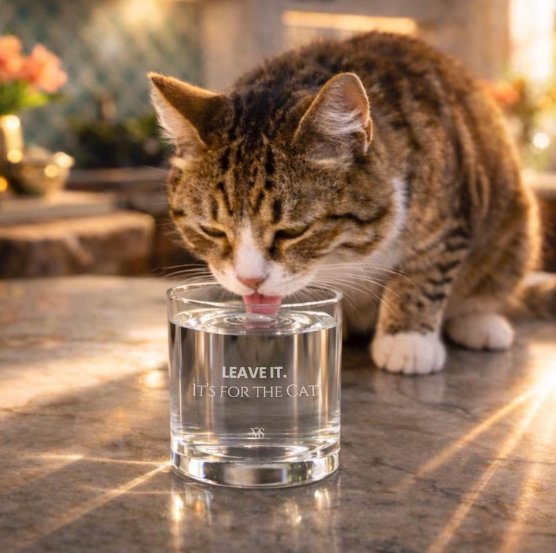
and found a cat, come from who knows where, drinking the water from the scholar's own cup.
Seeing the person awaken, the cat did not shy away, but went on drinking —
truly a spoiled little cat.
The scholar stretched lazily,
felt a soreness in the eyes,
and had no intention of reading further.
Tucking the bookmark between the pages,
giving the cat a passing stroke,
the scholar turned and departed.
Mythos & Kallos · Part 18 · Moirai γ
Upon hearing of the cat drinking water from a person's cup, B suddenly snapped awake from the haze of drowsiness.
B: Heavens — I truly cannot bear letting a little cat drink from a person's own cup. Don't you find that genuinely filthy, utterly unhygienic?
A: Friend, you look as though an unpleasant memory has been stirred.
B: Don't get me started. I have a friend of rather good standing with me — we kept in touch for many years after leaving school. Let me call this friend of mine T.
This friend of mine often lets his cat drink from a person's cup. Every time I saw T's cat doing this, I felt intensely vexed. A person should not let a cat drink from one's own cup.
A: T? That sounds like an interesting name.
B: That is not my friend's true name, but his pen name. T was originally the name of a general in our country's history.
A: Is your friend a writer, then? Or a devotee of military matters?
Speaking of his friend, B grew more and more animated, pouring forth to A the tale of T in an unbroken stream.
B:
Friend, you ask whether T is a writer or a devotee of military matters?
In truth, neither. He is no writer, nor any lover of the military arts.
In the history of our country,
T was a famous failure —
a general of a defeated army, a nation's disgrace, a dismal ending.
Yet my friend, for reasons unknown, felt such deep sympathy with this name.
A personal fondness?
A personal peculiarity?
Or a narcissistic emblem of solitary self-regard?
I truly do not know.
I once asked my friend:
Why are you so fond of using T as your pen name?
T answered me:
One long since dead,
universally mocked by those who came after.
People are willing to engrave in memory the erring ones who brought them glory,
yet can hardly keep from forgetting the failures who once saved them.
For at the mention of this ludicrous name,
everyone cannot help but summon up memories of shame.
O pitiable sinner,
you protected what was precious,
yet received no recognition that was your due.
Alas, alas —
lament, lament.
Amid the sleepless murmuring whispers of the dead,
are you truly content to return to rest?
I said to T:
Can you not speak like a normal person?
But T merely wagged his head with theatrical airs:
In the dark crevices of history,
can that little head of yours not hear the weeping of wronged souls?
I am the voice-bearer of their faint echoes.
Do not touch my cat — let it sleep in peace, will you?
I said:
All I hear is a fool talking to oneself.
B:
My friend, you know how it is —
people who study the hard sciences, like T,
all have something a little wrong in the head.
Ha ha, I am only joking.
But T truly does carry a childlike strain of cynicism against the world,
as though half of his soul still lingers in the rebellious season of youth.
Poor T —
his writing is a chaotic tangle,
now and then he mutters like one possessed,
and only I and a few others are willing to give it a glance.
A:
Oh — it sounds as though you two are good friends?
B:
Of course we are.
The older one grows,
the fewer the friends whom one meets without interest or gain.
I treasure still having T as a friend —
or perhaps only I can endure T,
willing to listen to those absurd pronouncements and tolerate his eccentric ways.
My friend,
can you imagine a person naming their own water cups?
T is precisely such a person.
Look at this photograph I took:
two utterly unremarkable cups,
one named Ordo Successivorum,
one named Ordo Coexistentium.
It is Latin.
A:
Do these two names carry some meaning?
B:
My friend said
they come from Leibniz (Gottfried Wilhelm Leibniz).
Ordo Successivorum means "the order of successive beings" (the order of things that follow one upon another),
Ordo Coexistentium means "the order of coexistent beings" (the order of things that exist together).
Ordo, Ordo — order, order.
Successivorum — the being of those that succeed.
Coexistentium — the being of those that coexist.
Succession is time,
coexistence is space.
One cup is time,
one cup is space.
All living creatures may drink,
and the little cat is no exception.
Ah —
the excuse of one who spoils and dotes.
Tell me, why is it that some people in this world
have more patience for their pets than for human beings, their own kind?
When we were still students,
whenever I asked T questions of mathematics and physics, T would show nothing but a face full of impatience:
Pseudo, Pseudo — false, false.
Friend, tell me, why is humankind like this?
A:
I do not know either.
B:
There are no perfect people in this world;
to find a friend one can truly converse with is already no easy thing —
so what is to be done?
I can only endure those flaws of T's that will never be mended.
Sometimes when chatting with T,
it looks like conversation,
but in truth each of us speaks our own speech;
the channels never quite align.
Yet I can partly understand what T is saying,
and T can partly understand what I am saying —
a conversation of parallel lines.
T calls this the inner product between person and person, and says it is truly a thing of regret.
I too regret that in this life I have spent no small amount of time listening to T speak heaps of meaningless idle words.
I asked T:
Why do you produce so many idle words?
Have you nothing else to do?
T said:
You do not understand —
idle words too have their own meaning of existence.
This world cannot be without idle words;
idle words should not suffer discrimination.
Whether a sentence is idle or not lies not in the sentence itself,
but in the Ordo Successivorum to which it is joined,
and in the Ordo Coexistentium to which it is linked.
Do you feel the pulse of time and space?
Idle words are, in truth, alive!
They are waiting for people to fish them up at just the right moment, in just the right place!
B:
It is truly difficult for people to communicate with one another —
friend, do you ever have this feeling?
T's other half once complained to me:
sometimes one truly wishes to throw T out of the house together with that cat of his.
This person would sometimes rather listen to a cat's mewing than properly listen to another human speak —
for which I expressed my deepest sympathy.
Perhaps human beings can only ever partly understand one another.
Some marriages are like friendships:
they appear intimate, yet require a wise distance;
some friendships are like marriages:
they appear without connection, yet raise no fences.
I cannot make sense of these things either —
to be born human is truly troublesome.
I am a little hungry; I think I shall order some bread. Friend, would you like any?
A:
None for me, friend.
B:
Where was I?
Ah, I remember now.
Do not be fooled by how T keeps Leibniz forever on his lips —
he superstitiously believes that food fallen on the floor for no more than five seconds may still be picked up and eaten.
I said to T:
Does the number of seconds here truly make any difference?
Is not the important thing the irreversible fact that the food has already fallen to the ground?
The floor teems with disease-bearing pathogens.
T:
But I am not dead yet, am I?
B:
That is because the human body still possesses antibodies and other mechanisms of defense.
The harm has in truth already been done;
the body has borne it all in an attrition beneath the threshold of awareness.
Trust in science; do not place superstitious faith in the naked eye.
Just as you should not let your cat drink your water —
a housecat looks clean,
but who knows how many bacteria and viruses it carries?
T:
Natural selection —
what does not kill me makes me stronger
(Was mich nicht umbringt, macht mich stärker).
B:
Your doctor would certainly never say that.
What does not kill you will only make your medical insurance ever more expensive.
T:
Have I ever told you —
my doctor is a supreme obsessive-compulsive,
who utterly despises anyone meddling with his things.
Even meaningless bills and receipts
must be placed in their appointed positions, arranged in their appointed manner.
Can you imagine a person spending great swaths of each day planning how such objects ought to be arranged?
B:
With so methodical a doctor,
you may enter the operating theatre one day with a somewhat easier heart.
T:
I only hope my doctor will not agonize over whether my duodenum is untidy.
B:
It might be cranial surgery, you know.
Once opened, anyone could see that your brain is disordered beyond all salvation.
T:
This world brims with amazing correlations;
chaos is sometimes merely an order not yet discovered,
and forcible tidying does not always accord with elegant taste.
Would you kindly let it sleep in peace?
B:
Don't you think your cat is a little too fat?
T:
What is wrong with a cat being a little plump?
B:
You have made it lose its vigilance toward the world.
Natural selection — out there it could never survive.
Doting indulgence does not accord with the Order of Nature.
T:
It is very timid.
B:
And so?
T:
It is very timid,
and so the moment it senses a threat, it seeks the help of humans.
In this place where humans are everywhere,
it can survive with great success.
B:
And suppose one day it runs off to some place without people?
Or suppose the person it meets harbors malice toward it?
T:
Who would ever wish to harm so adorable a little cat?
You always hold too much suspicion and malice toward the world.
B:
Me, for instance — look, it is so vexed by me it is about to bite.
T:
Why must you insist on waking it?
B:
It once drank from my cup as well.
T:
You truly do hold grudges.
B:
This is not grudge-holding.
I am making this fat little cat remember
that not just anyone's cup may be drunk from —
this is the order one must obey to survive in the human world.
T:
That is precisely grudge-holding.
You should not torment a little cat over such an inconsequential rule.
B:
No — this matters.
At the very least, it matters to me.
So it had best remember: next time, do not drink from my cup again.
At this moment the bread B had ordered arrived, fresh from the oven, its fragrance most inviting.
B: Friend, will you have some? Shall I share a little with you?
A: I am not hungry — please, eat.
B paid no heed to A's polite refusal and shared half the bread with A all the same. A declined no further, and received it with an easy hand.
A: Thank you, my friend.